
Sales leaders know that activity drives results. Yet what is often underestimated is the psychological effect of connecting action with visible progress. When sales professionals can observe the immediate impact of their efforts in near real-time reporting, motivation strengthens and performance improves. This connection is not accidental—it is grounded in well-documented psychological principles around motivation, reinforcement, and feedback loops.
The Science Behind Action and Feedback
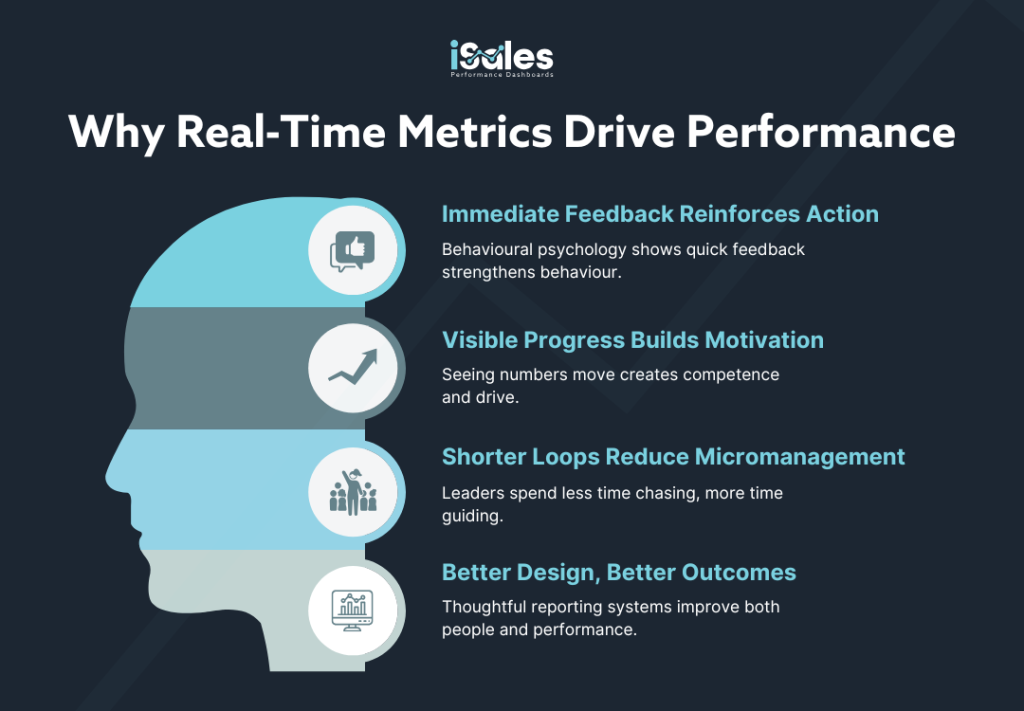
Behavioural psychology shows that the closer feedback is to the action, the stronger the reinforcement. B.F. Skinner’s operant conditioning framework demonstrated that immediate reinforcement increases the likelihood of behaviour being repeated. In sales, that might mean a representative making a client call and quickly seeing the opportunity reflected in their dashboard. The act and its consequence are tied together in the mind, making the behaviour more likely to recur.
Research into intrinsic motivation also emphasises the importance of progress visibility. Amabile and Kramer’s “progress principle” highlights that small, visible wins—such as seeing pipeline value increase—create positive emotion and sustained motivation. Similarly, Deci and Ryan’s self-determination theory identifies competence (the sense that one’s actions make a measurable difference) as a core driver of performance.
Near real-time reporting satisfies this need by providing tangible proof of progress, almost as if the salesperson can “see the numbers move” the moment they act.
There is also a managerial dimension. When performance reporting lags, managers often feel compelled to intervene, sometimes excessively. Near real-time reporting reduces this need, allowing executives to step back and trust that the visibility of results will guide behaviour more effectively than micromanagement.
Practical Steps for Sales Leaders
- Shorten the reporting cycle
Move from end-of-month or weekly updates to daily or near real-time dashboards. This ensures feedback loops reinforce behaviour quickly. - Map actions to outcomes
Design reporting that explicitly shows how specific behaviours—calls made, proposals sent, deals closed—flow through to key metrics. - Incorporate psychological cues
Use visual design (progress bars, real-time pipeline shifts) to help salespeople see their progress. Where possible, layer in auditory or tactile prompts (e.g., notifications, alerts) to engage multiple senses. - Connect to targets directly
Ensure every action displayed in reporting links back to broader goals. A salesperson should immediately understand how one action moves them closer to quota. - Leverage reporting to manage less
Encourage managers to use dashboards as a trust mechanism. If visibility is strong, oversight can shift from monitoring every step to guiding strategy.
Common Pitfalls
- Delayed updates: Feedback arriving days later loses motivational impact and weakens the link between behaviour and results.
- Data overload: Overcomplicated dashboards obscure the action-result connection. Clarity is more valuable than comprehensiveness.
- Managerial overreach: Even with strong reporting, if leaders continue to interfere at a task level, the psychological benefit of autonomy is undermined.
- Ignoring the human element: Metrics are not just numbers—they represent actions, progress, and motivation. Treating them as cold outputs risks disengagement.
A summary
Sales professionals thrive when their actions are visibly tied to outcomes. Near real-time reporting strengthens motivation by reinforcing behaviour through immediate feedback, aligning with established psychological principles of reinforcement, intrinsic motivation, and progress visibility. Executives benefit too: stronger motivation, less need for intervention, and a sales force driven by the satisfaction of seeing results unfold as they act.
Consider how your reporting systems can close the gap between action and visibility—because the shorter the loop, the stronger the performance.